
Perry Scheduled vs Actual Release
A scheduled date is not the same as an actual release. In Alabama state custody, ADOC defines "Minimum Release Date" as the earliest scheduled date an inmate can be released to probation or end of sentence. ADOC also says the date can change if good time is lost, if a circuit clerk sends new cases, or if the sentence changes. For a Perry County jail sentence, the sheriff or receiving jail may need to explain any local sentence calculation because no Perry-specific written jail good-time policy was found in the sources reviewed.
Find Perry County Release Date
The search path should match the custody source. A person awaiting trial may be released by bond, court order, dismissal, or transfer, not by a fixed scheduled release date. A sentenced county-jail prisoner may require jail records and the court sentencing order. A state prisoner requires ADOC fields, ABPP parole information, and VNS or records-request follow-up.
- Identify whether the person is in Perry County jail custody, an out-of-county holding jail, ADOC, federal custody, ICE custody, or ABPP supervision.
- For county jail custody, call the Perry County sheriff or jail records line and ask for sentence status, release reason, and any local calculation.
- For state custody, use the ADOC inmate search while the person is currently incarcerated.
- Read ADOC's definitions for Minimum Release Date, Parole Consideration Date, and Parole Status.
- Check ABPP hearing and result pages when parole eligibility, grant timing, or mandatory release may affect the date.
- Confirm the sentencing order, custody time applied by the court, bond order, or disposition through Perry County court records.
For release alerts after a date is known, use the VINELink release check page. For a person already released, the broader Perry County released inmates workflow is usually a better fit.
Perry ADOC Date Fields
ADOC's public search is current-only. It accepts AIS number, first name, and last name, and ADOC says the six-digit AIS number takes precedence over name fields. If a former state prisoner is no longer in current ADOC custody, the public search may return no result. That no-result should not be called proof of release unless VNS, ABPP, court, or ADOC records confirm it.
| ADOC field | Meaning for release-date lookup |
|---|---|
| AIS number | Unique six-digit inmate number and the most precise search key. |
| Minimum Release Date | Earliest scheduled release to probation or end of sentence, subject to change. |
| Parole Consideration Date | Tentative parole-board consideration timing, not a release promise. |
| Parole Status | Shows parole, delinquent, or revoked status while available in the record. |
The manifest includes Alabama Code Section 14-9-41 for this page: the correctional incentive time statute explains good-time classifications.
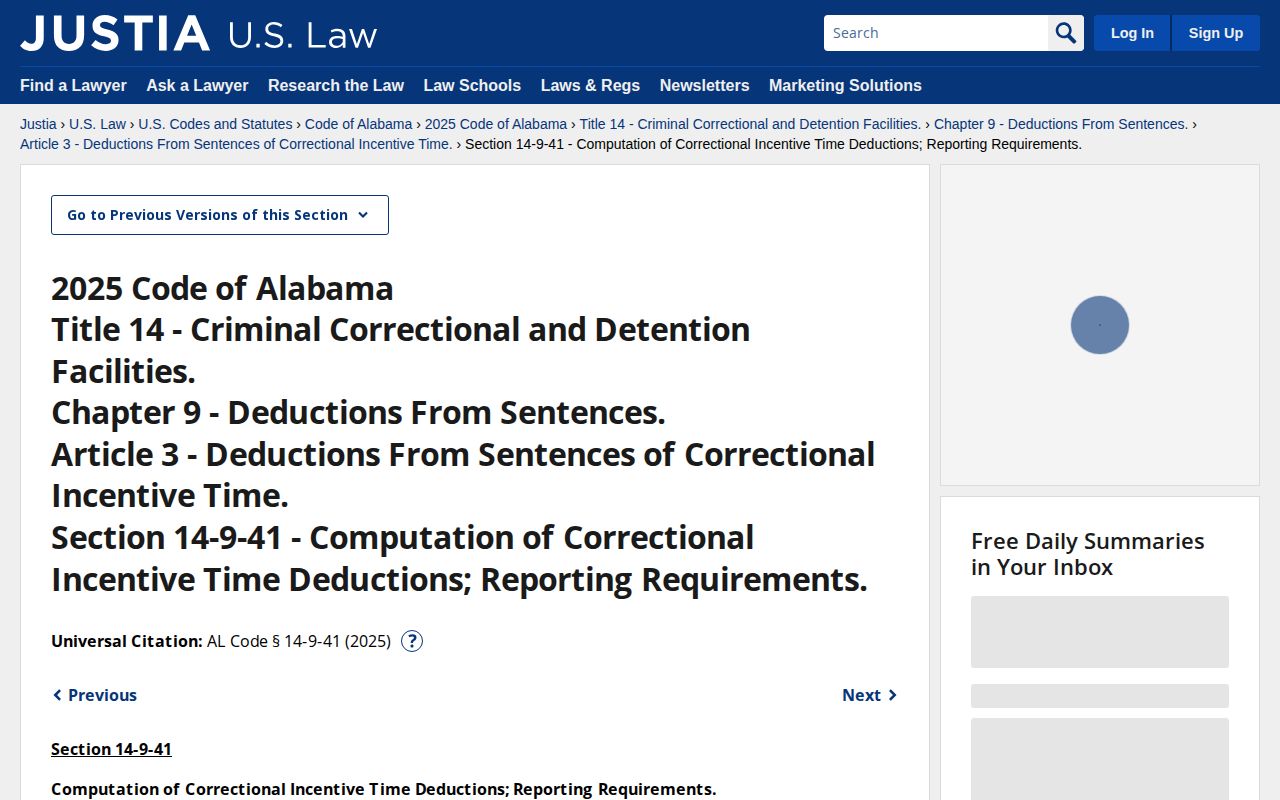
That statute matters because earned-time rules can shorten an eligible sentence, while exclusions or lost time can change the expected date.
Perry Good-Time Computation
Alabama Code Section 14-9-41 governs correctional incentive time. The statute provides thirty days per thirty days served for Class I, fifteen days per thirty days for Class II, five days per thirty days for Class III, and no incentive time for Class IV. It also lists exclusions, including Class A felony conviction, a crime causing death by deadly weapon, life or death sentence, sentence over fifteen years, and sex offense involving a child.
The same statute separates administration by custody type. ADOC's chief administrative officer administers incentive time in state institutions. The sheriff administers it as applied to county-jail prisoners. That is the Section 19 angle for Perry County: a county-jail release computation and a state-prison Minimum Release Date are related by state law, but they are not the same office or the same record.
Perry Release Date Changes
Release dates can change after the first lookup. ADOC names lost good time, new cases sent by a circuit clerk, and sentence changes. Court records may add or correct custody time applied to the sentence. ABPP may deny parole, grant parole subject to release-plan verification, continue a hearing, reset consideration, or coordinate mandatory release to supervision. A detainer, hold, transfer, or federal or immigration pickup can also turn a local release into another custody event.
| Change | Where to verify |
|---|---|
| Lost or restored good time | ADOC for state custody, sheriff for county sentence calculation. |
| New case or amended sentence | Perry County Circuit Clerk and Alacourt. |
| Parole grant or denial | ABPP scheduled hearings, current results, and archives. |
| Mandatory release | ADOC eligibility and ABPP coordination. |
| Detainer or transfer | Jail records, receiving agency, BOP, ICE, or USMS. |
Perry Parole Date Limits
ABPP says parole eligibility is calculated under Alabama Code Section 15-22-28(e). The calculation can consider sentence, offense, custody time applied by the court, good-time eligibility, time served, and sentencing-court orders. The statute has an 85-percent or fifteen-year initial parole-consideration rule for certain listed Class A felonies committed on or after March 21, 2001. For other prisoners, the general initial consideration point is completion of one-third of the sentence or ten years, whichever is less.
Mandatory release is separate. ABPP explains Section 15-22-26.2 as an automated release-to-supervision mechanism for eligible offenses committed on or after January 30, 2016, with exclusions for child sex offenses and life sentences. The public date question should be framed as official calculation, not a fixed percentage for every Alabama sentence.
A Perry County court sentence can also create confusion when a person moves from local custody to state custody. The county jail record may show transfer to ADOC, not final discharge. The ADOC record may then show a Minimum Release Date while the person is current. After release, the public ADOC search may stop showing the person because ADOC says historical data is not available online. At that point, VNS, ABPP, court records, and ADOC records requests become more useful than repeated name searches.
If the person was held in another county during the Perry County Jail closure, ask both Perry County and the receiving jail about sentence calculation and release processing. Perry County may explain the case, sentence, warrant, or court order. The receiving jail may explain the physical release date, property return, or transfer out of that facility. Those two answers should be reconciled before treating a projected date as final.
For a pretrial detainee, avoid asking for a projected release date as if one always exists. The better questions are whether bond has been set, whether a court order authorizes release, whether another hold blocks release, and whether the person has been moved to another agency. For a sentenced county-jail term, ask for the local sentence calculation and the release reason. For a state sentence, ask for the AIS number, Minimum Release Date, parole consideration date, mandatory release status, and any public discharge record available from ADOC.
Dates should be saved with their source. A court date, a jail release date, an ADOC Minimum Release Date, a parole consideration date, and a VNS alert date are not interchangeable. They may all be true, but they answer different parts of the custody timeline. Perry County release-date work is strongest when each date is labeled with the system that produced it.
ADOC public-record requests may be needed when the online search stops answering the question. The current ADOC public records form reviewed in the research asks for identifying details, Alabama residency attestation, a description of the requested records, preferred format, and signature, and it states a non-refundable $20 processing fee. A precise request for release date, discharge date, custody status history, and supervision-transfer notation is more useful than a broad request for every record.
For Perry County court records, ask for the docket, sentencing order, bond or release order, probation order, or disposition. The Circuit Clerk can identify public-record access procedures, while Alacourt ACCESS and Just One Look may provide online trial-court records. Court records often explain why release was authorized even when they do not show the exact jail-door time. Keep copies of each response for date comparison.
Public Record Search
Sponsored Results